

Abstract
IgG4-related disease is a phenotypically heterogeneous systemic autoimmune and inflammatory disease. The described phenotypes of this rare disease include (a) Pancreato-hepatobiliary disease, (b) head-and-neck limited disease, (c) retroperitoneal fibrosis and/or aortitis and (d) Mikulicz’s syndrome with systemic involvement. However, IgG4-related hepatopathy has not been well described in the literature with very few cases reported so far. We present a case of a 72 years old male who presented with itching, icterus and elevated liver function tests, and was diagnosed with IgG4-related hepatopathy based on histopathology. Patient had remarkable resolution of symptoms and laboratory abnormalities with corticosteroids and did not need additional immunosuppressive agents.
Ethics Approval
The Mayo Clinic Institutional Review Board (IRB) acknowledges that based on the responses submitted for this new activity through the Mayo Clinic IRBe Human Subjects Research Wizard tool, and in accordance with the Code of Federal Regulations, 45 CFR 46.102, the above noted activity does not require IRB review.
Case Presentation
72-years old male with a history of diabetes mellitus type-2 and hypertension presented with itching. On exam, he had icterus with no organomegaly. Labs revealed total bilirubin 9.8 mg/dL, alanine aminotransferase (ALT) 195 U/L, aspartate aminotransferase (AST) 127 U/L, Alkaline phosphatase (ALP) 566 U/L, and normal INR. Viral hepatitis A, B, and C panels were negative. Serological workup revealed positive antinuclear antibody (1:160), positive anti-alpha smooth muscle actin antibody (1:20), and negative antimitochondrial antibody. Serum immunoglobulin-G4 (IgG4) was greater than 300 mg/dL (reference range 4-86 mg/dL). Ca19-9 was elevated at 990 IU/mL. Computed tomography of the abdomen showed intrahepatic biliary duct dilatation with wall thickening of the common bile duct. Magnetic resonance imaging with cholangiopancreatography showed slightly prominent irregular biliary ducts in the left hepatic lobe but no pancreatic/ampullary lesion.
Liver biopsy was performed and it revealed lymphoplasmacytic infiltrate in portal tracts without significant interface activity. Periductal fibrosis with increased IgG4 positive plasma cells (20/hpf) was noted. The majority of the plasma cells were IgG4 and MUM1 positive on the immuno-stains. The other findings were focal lobular lymphoplasmacytic inflammation, hepato-canalicular cholestasis with focal cholate injury, scattered ceroid-laden macrophages, and minimal steatosis. Portal fibrosis was seen on the trichrome stain and minimal (1+) hemosiderosis was seen on the iron stain. CK7 immunostain showed intact interlobular bile duct branches with scattered intermediate liver cells. The copper stain was negative (Figures 1 and 2).
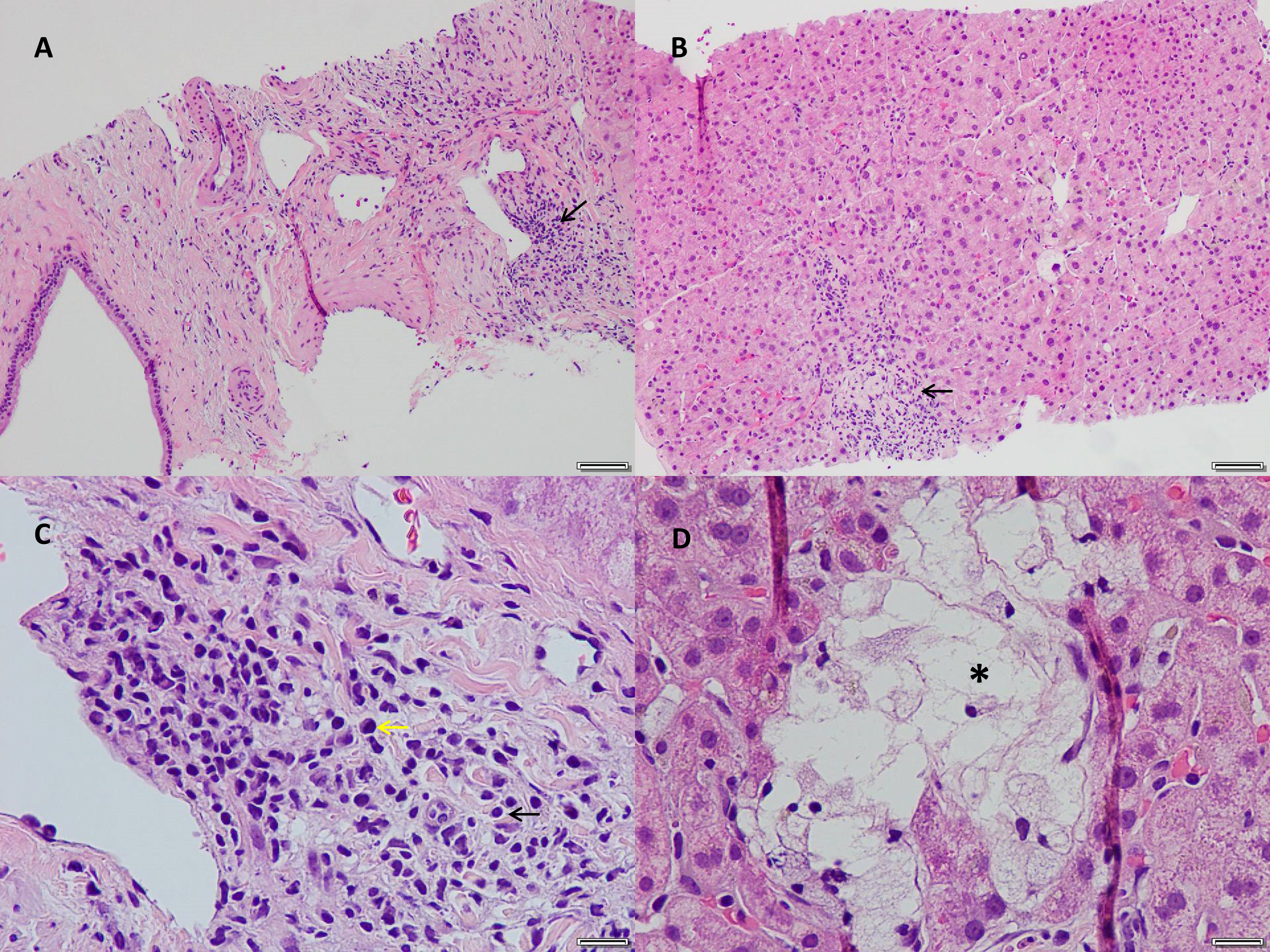
Figure 1: Liver Biopsy. H&E stain. A. Original magnification x 40: Periportal lymphoplasmacytic infiltrate (arrow). B. Original magnification x 100:Lobular inflammation (arrow). C. Original magnification x 200: Inflammation with lymphocytes (black arrow) and plasma cells (yellow arrow). D.Original magnification x 400: Focal cholate injury (asterisks).
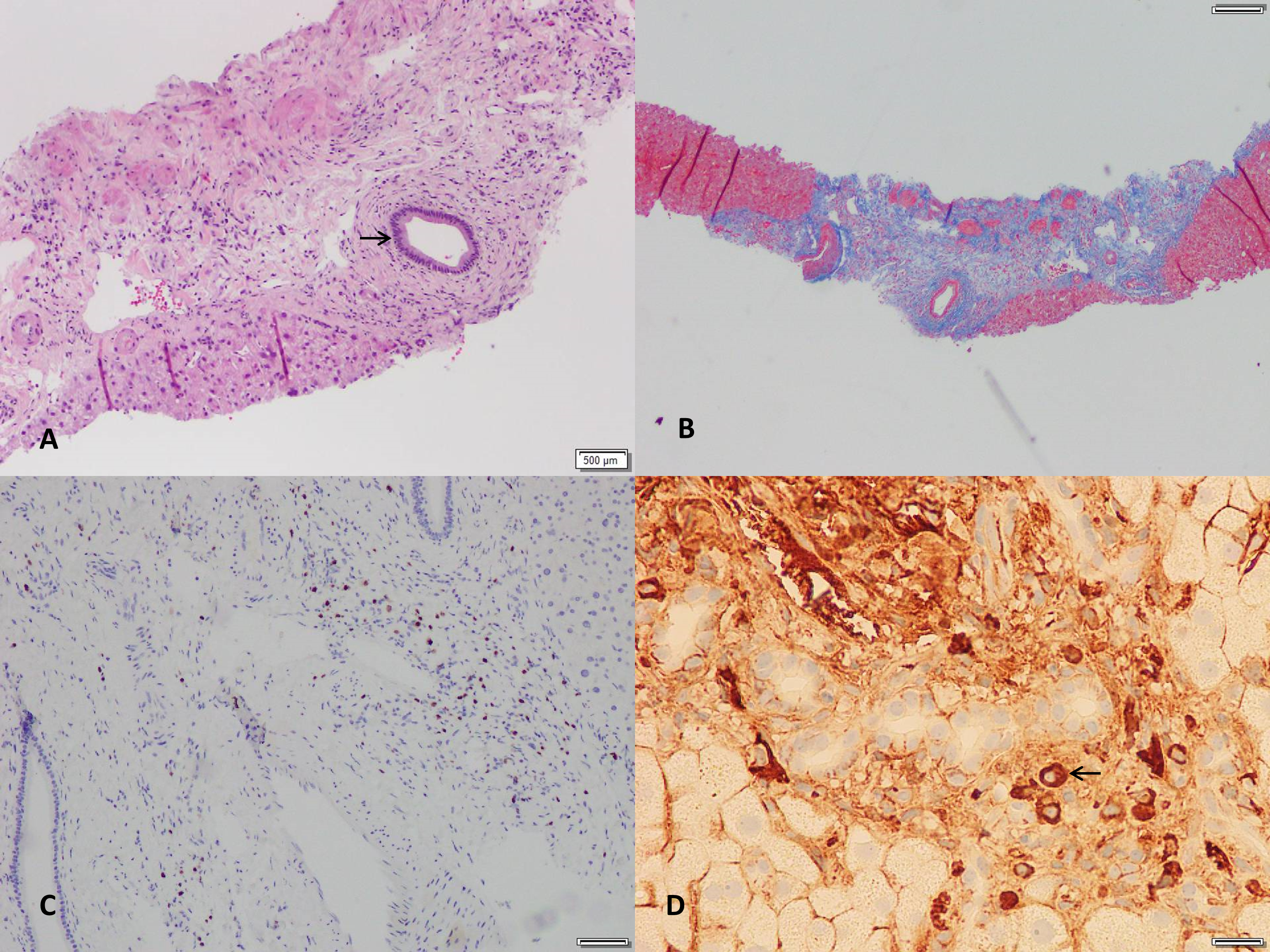
Figure 2: Liver biopsy. A. H&E stain, Original magnification x40: Bile duct with surrounding periductal fibrosis (arrow). B. Original magnification x20:Periportal fibrosis highlighted in blue by trichrome special stain C. Original magnification x40:MUM1-positive lymphocytes highlighted in brown by MUM1 immunohistochemical study. D. Original magnification x400:IgG4-positive plasma cells (arrow) highlighted by IgG4 immunohistochemical study.
The patient was treated with prednisone 40 mg daily for 4 weeks following which, his LFTs normalized. Prednisone was tapered over the next 6 weeks, and the patient was followed for 1 year during which, the patient remained asymptomatic, and his liver function tests stayed normal.
Discussion
IgG4-related disease (IgG4-RD) is a systemic inflammatory disease characterized by IgG4 positive plasma cell-rich dense lymphoplasmacytic infiltration, storiform fibrosis, and obliterative phlebitis [1]. Any organ can be involved, and the disease is more common in middle-aged men [2]. Clinical presentation is typically that of organ swelling secondary to the inflammatory pseudotumor, and symptoms secondary to the involved organ damage, both responding well to corticosteroids. IgG4-RD is heterogeneous and 4 different phenotypes have been described (a) Pancreato-hepatobiliary disease, (b) head-and-neck limited disease, (c) retroperitoneal fibrosis and/or aortitis and (d) Mikulicz’s syndrome with systemic involvement [3]. Definite diagnosis requires clinical and pathological correlation. Serological and radiological studies alone are often insufficient in confirming the diagnosis, and a definite diagnosis often requires a histological examination of the organ involved.
Liver and biliary tract involvement have been described in IgG4-related disease, although the liver disease associated with IgG4-RD including IgG4-related autoimmune hepatitis and IgG4-related hepatopathy has not been well characterized [4]. IgG4-related hepatopathy includes primary hepatic involvement in systemic IgG4-RD and secondary hepatic changes due to IgG4-related sclerosing cholangitis [5]. Portal and lobular inflammation with dense lymphoplasmacytic infiltration (≥ 10 IgG4+ plasma cells/HPF) predominate in primary IgG4-related hepatopathy [5,6]. Elevated serum IgG4 levels are an important clue, although they can be normal in a substantial percentage of patients with IgG4-related disease and are no longer considered essential to the diagnosis of IgG4-RD [7]. Autoimmune hepatitis, malignancies such as lymphomas and infections such as syphilis are histopathologic mimics of IgG4-related hepatopathy and shall be carefully ruled out.
IgG4-RD and IgG4-related hepatopathy are usually responsive to corticosteroids, which are the first line of therapy for induction of remission [8]. Steroid-sparing immunosuppressive agents including mycophenolate mofetil, azathioprine, methotrexate, tacrolimus, and cyclophosphamide have been used both as induction and maintenance therapy, although prospective randomized clinical trials are generally lacking [9]. Rituximab has been used for corticosteroid-refractory and severe cases [10]. Emerging therapeutics with ongoing trials include XmAb5871 (a humanized monoclonal antibody against FcγRIIb and CD19), inebilizumab (a humanized monoclonal against CD19), abatacept and leflunomide.
Financial Disclosure and Conflict of Interest Statement
We confirm that the authors have no financial disclosures, competing interests and conflict of interest. The study has not received any financial support or other benefits from commercial sources for the work reported in the manuscript.
Author contributions
All authors have made significant contributions to the manuscript. All authors have read and approved the final version of the manuscript. The manuscript is being submitted by the corresponding author on behalf of all authors and represents the original work of all authors and has not been submitted for publication elsewhere.
Patient Consent
Written informed consent was obtained from the patient for publishing this material.
References
2. Wallace ZS, Deshpande V, Mattoo H, Mahajan VS, Kulikova M, Pillai S, et al. IgG4‐related disease: clinical and laboratory features in one hundred twenty‐five patients. Arthritis & Rheumatology. 2015 Sep;67(9):2466-75.
3. Wallace ZS, Zhang Y, Perugino CA, Naden R, Choi HK, Stone JH. Clinical phenotypes of IgG4-related disease: an analysis of two international cross-sectional cohorts. Annals of the Rheumatic Diseases. 2019 Mar 1;78(3):406-12.
4. Lee HE, Zhang L. Immunoglobulin G4-related hepatobiliary disease. InSeminars in Diagnostic Pathology 2019 Nov 1;36(6):423-433.
5. Nakanuma Y, Ishizu Y, Zen Y, Harada K, Umemura T. Histopathology of IgG4-related autoimmune hepatitis and IgG4-related hepatopathy in IgG4-related disease. InSeminars in liver disease 2016 Aug;36(3):229-241.
6. Perricone G. Hepatic involvement in IgG4-related disease: IgG4-hepatopathy and IgG4-autoimmune hepatitis. Autoimmunity Reviews. 2015;3(14):268.
7. Wallace ZS, Naden RP, Chari S, Choi H, Della‐Torre E, Dicaire JF, et al. The 2019 American College of Rheumatology/European League Against Rheumatism classification criteria for IgG4‐related disease. Arthritis & Rheumatology. 2020 Jan;72(1):7-19.
8. Khosroshahi A, Wallace ZS, Crowe JL, Akamizu T, Azumi A, Carruthers MN, et al. International consensus guidance statement on the management and treatment of IgG4-related disease. Arthritis and Rheumatology. 2015 Jul 1;67(7):1688-99.
9. Omar D, Chen Y, Cong Y, Dong L. Glucocorticoids and steroid sparing medications monotherapies or in combination for IgG4-RD: a systematic review and network meta-analysis. Rheumatology. 2020 Apr 1;59(4):718-26.
10. Carruthers MN, Topazian MD, Khosroshahi A, Witzig TE, Wallace ZS, Hart PA, et al. Rituximab for IgG4-related disease: a prospective, open-label trial. Annals of the Rheumatic Diseases. 2015 Jun 1;74(6):1171-7.