

Abstract
Anaphylactic reactions to snake venom have been poorly documented in the scientific literature. The populations at risk are people exposed to multiple bites or workers in venom extraction or toxin research centers constantly exposed to liquid, lyophilized, or powdered venom aerosols. Based on the report of a case of anaphylaxis suffered by one of us exposed to snake venom for 30 years, we underline the threat of this type of violent reaction as an occupational hazard to the exposed population and the need for preventive measures to minimize its frequency and consequences.
Keywords
Anaphylactic reactions, Snake venom, Venom extraction, Toxin research
Introduction
Snake venoms are complex mixtures of bioactive substances that play an essential trophic and defensive role by acting on the target animals in which they are inoculated. More than 100 toxins of varied chemical nature can make up the venom of a single snake [1]; however, enzymes, non-enzymatic proteins, peptides, biogenic amines, lipids, and free amino acids prevail. The pathophysiological effects of this plethora of components have been well characterized for most clinically relevant species [2,3]. In turn, this allows the design of specific antivenoms to neutralize those [4].
Despite these advances, some aspects of snake envenomation remain elusive and have not received the same approach in the scientific literature as toxin studies. One of these challenging aspects is the ability of snake venom to act as an allergen and generate acquired immune responses, reactions that could further compromise the precarious situation of people affected by snakebite. The variety of components and their protein nature make animal venoms a source of allergens that can induce hypersensitivity, especially IgE-mediated type I hypersensitivity, and trigger severe vascular or respiratory reactions that vary according to the patient's response and the nature of the insult. These reactions are well known in the case of hymenopteran and other arthropod stings [5]. However, they have been less described in the case of bites generated by vertebrates, particularly venomous snakes [6-8]. Anaphylactic and anaphylactic-type reactions generated by these reptiles are considered rare [5,9], although it has been suggested that all families of venomous snakes can potentially provoke allergic reactions [10,11].
The few reports available on moderate and severe hypersensitivity to snake venom primarily involve snake handlers who have been repeatedly bitten, but also people who work directly with venom and thus have been exposed multiple times to the allergen [8,12]. Thus, the population at risk of venom-mediated hypersensitivity usually includes serpentarium employees who supply venom to the pharmaceutical industry, workers in antivenom production facilities, or researchers in toxinology. In these cases, environments saturated with venom aerosols (during venom extractions or cage cleaning) or direct contact with the skin of the hands and face can generate hypersensitivity [13]. Common reactions reported in the population at risk involve mainly mucous membranes of the eyes, upper respiratory tract, and urticaria [6]. More severe systematic anaphylactic reactions have also been recorded [8,10].
Here, we report a case of anaphylaxis caused by snake envenomation in a patient with a history of previous exposure to snake venom. We discuss the scope of these severe reactions as an occupational hazard to which workers exposed to snake venom are subjected.
Case Presentation
A 52-year-old male patient, 140 kg, prediabetic and diagnosed with kidney stones for a year. The patient has a history of prolonged exposure to viper and elapid venom as a researcher in snake ecology and toxinology for over 30 years. His work activities include frequent contact with crude and lyophilized venom during the extraction and research processes. The patient received polyvalent antivenom (Instituto Clodomiro Picado, Costa Rica) treatment in 1988 after a Bothrops asper (fer-de-lance snake) bite. He reported sensitivity to the venom of this species during the last ten years, with urticaria at sites of contact with the venom (palms, digits) and conjunctivitis that developed within a few minutes from exposure. There was no evidence of similar reactions when handling venoms from other Neotropical vipers.
On May 4, 2022, during a venom extraction using hematocrit capillaries at the Rosy Walther Zoo, Honduras, the distal phalanx of the right index finger was injected by the left fang of a 3-year-old specimen of the Honduran jumping pitviper Metlapilcoatlus indomitus (Figure 1A). Venom from the corresponding gland had already been partially extracted, and the accident occurred when doing a last attempt to empty the gland. Although it was impossible to determine the exact amount of venom injected, fewer than five microliters of venom were inferred from the volume supplied by the right gland. Envenoming was confirmed by moderate local pain at the puncture site and subsequent swelling of the affected digit (edema extending to the carpal region). A bloody blister and possible skin necrosis at the puncture site were also noticed around three hours after the puncture (Figure 1B). The patient had never before been exposed to the venom of this species.
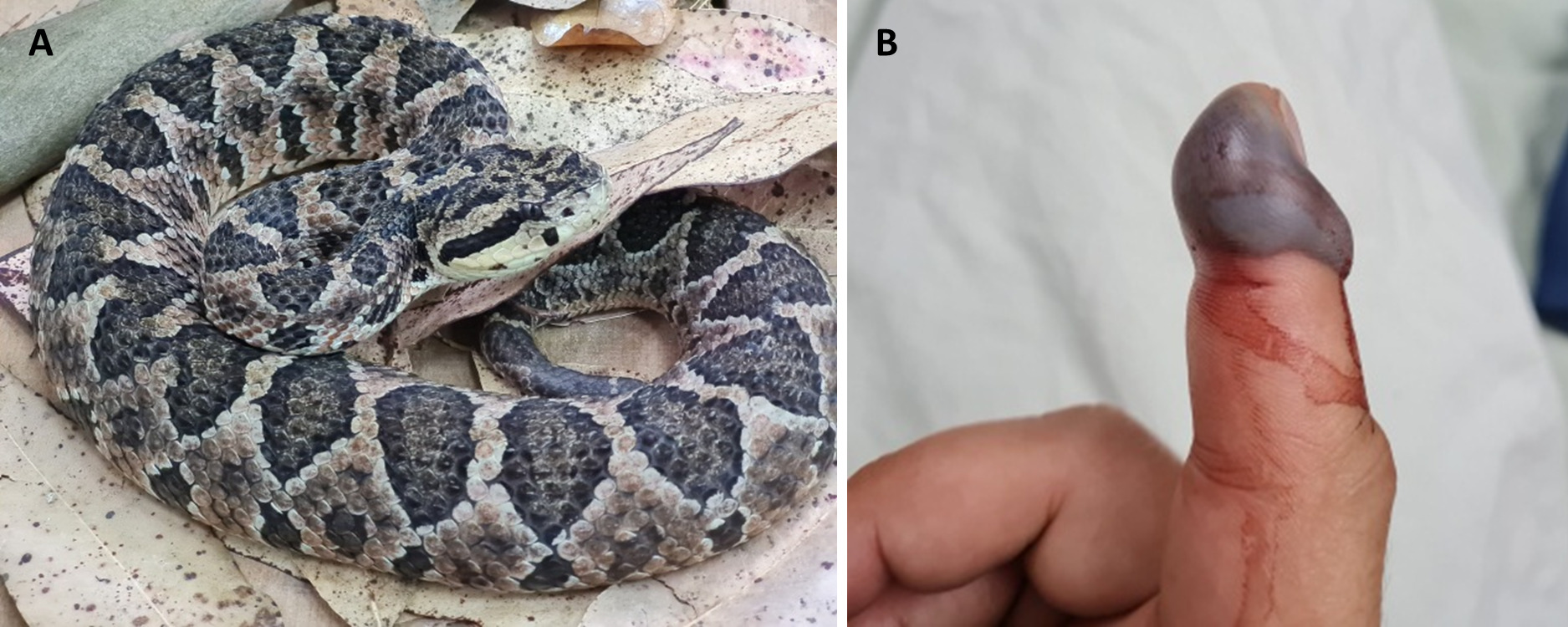
Figure 1: A) Metlapilcoatlus indomitus from Honduras. B) Evidence of local envenomation in patient’s finger.
Immediately after the puncture, the inoculation site was cleaned using soap and water, lightly pressing the digit to release blood. During the first two minutes after the inoculum, there was copious sweating and paresthesia/stinging in the palms of the hands and feet, accentuated in the latter region by an intense heat sensation. Eye redness and periorbital swelling were evident. Generalized discomfort was noted during the first 15 minutes when progressive dyspnea was also evident. Mild dysarthria was also noticed, with slightly more evident hoarseness. Airway obstruction was exacerbated about 20 minutes after injection. The patient was injected i.v. with 1 ml epinephrine (1mg adrenaline) heading to the hospital. Despite being relieved momentarily, a new airway closure was recorded minutes later upon arrival at the emergency department of the Hospital Escuela Universitario de Honduras (HEU).
At HEU, the patient was admitted with dyspnea, accompanied by erythema that spread to the right hand, arm, back, and legs. The initial evaluation reveals hypersensitivity, tachycardia, slow capillary refill, and hypotension, associated with hemodynamic instability. Most blood chemistry and hemogram parameters 90 minutes after the sting showed normal values, except for glucose concentration (155 mg/dL), creatinine (1.54 mg/dL), white blood cell count (13,310/μl); mean corpuscular hemoglobin concentration MCHC (32.g/dL), Red Cell Distribution Width (RDW) 15.0%, number of lymphocytes (6040/μL). Although D-Dimer was elevated (1.78mg/L), arterial blood gas parameters and coagulation times were normal. The general urine examination showed few epithelial cells, intact erythrocytes at 8-10Xcamp, and abundant calcium oxalate crystals. These results and the alterations in blood parameters noted may result from the previous condition of the patient. Further clinical analysis results (15 hrs) were similar, with normal electrocardiogram and sinus rhythm.
As intravenous therapy, the patient was treated with isotonic Hartmann's solution (sodium lactate). Diphenhydramine hydrochloride (500 mg), methylprednisolone (40 mg), hydrocortisone, and loratadine (10 mg/day) were administered to treat the allergic reaction, as well as paracetamol to relieve pain at the bite site. No antivenom of any kind was administered at the request of the patient. He was kept under observation for 24 hours and discharged when clinical improvement was verified, indicating outpatient management with Prednisone (50mg) and diphenhydramine (25mg).
Discussion
Immediate type I hypersensitivity reactions are mediated by IgE and related to the action of a variety of mediators released from mast cells and basophils upon degranulation. These reactions may vary in their severity, from mainly local reaction in the skin and mucous membranes to severe systemic, life-threatening reactions [14]. Although we did not corroborate involvement of IgE in the allergic response presented here, due to the patient's history and the perceived symptoms, it is very likely that this antibody-type mediated the reaction. The clinical expression of venom-associated anaphylaxis includes local burning pain, numbness, urticaria and angioedema, respiratory distress, dizziness, hypotension, arrhythmia, and syncope [15-17]. Other symptoms are gastrointestinal disturbances, shock, airway closure, allergic angina, and allergic myocardial infarction [18]. As with other allergens, snakebite-derived anaphylaxis can lead to death if severe enough.
Although few studies have attempted to address the epidemiology of allergic reactions to snake venom in the population at risk, its incidence could be higher than previously thought [9,19]. Often, a new bite triggers severe symptoms [7,15]. Although the reaction can start by inhalation or contact without the venom having been injected [11,19]. As with other occupational allergens [20], the exposure time may determine the level of sensitization to snake venom in the population at risk. de Medeiros et al. [19] found a significant association between sensitization to Bothrops jararaca (yararaca snake) venom and allergen exposure time. These authors suggest that the total number of years working with venom or venomous snakes can be considered a simple indicator of the level of accumulated exposure.
In our case, hypersensitivity to Metlapilcoatlus indomitus venom was triggered after repeated exposure to Bothrops asper venom. Thus, hypersensitivity can be elicited by venoms from species other than those previously exposed, sometimes even in different snake genera, showing cross-reaction in the allergic response [7,8,12]. Cross-reactivity in IgE-mediated allergic response to unrelated venoms has also been observed, especially between Hymenoptera and snake venom [14,21]. The overlap in toxin expression in different species could explain the cross-reactions, even when this overlap is limited to one or few components [22].
The cross-reactivity with unrelated allergens could also explain some cases in which patients show severe hypersensitivity to snake venom without prior exposure. Palgan et al. and Frangides et al. [14,18] reported two cases of snakebite envenomation that generated an anaphylactic response without evidence of previous exposure. In the first case, a 58-year-old patient with no history of previous bites but with a history of Hymenoptera stings was bitten by a Vipera berus (common European viper). The anaphylactic reaction was attributed to cross-reactivity between viper venom and Hymenoptera, and laboratory tests did not confirm allergic sensitization to the supplied antivenin. In the second case, a 60-year-old man was bitten by Vipera ammodytes (horned viper) and developed an acute allergic reaction, confirmed by increased histamine and tryptase levels. The observed hypotension and coronary vasospasm were attributed to anaphylaxis. More recently, Rencher et al. [22] added a third case: a 14-year-old boy with no history of prior exposure to venom who developed edema of the face and oropharynx, a hoarse voice, and respiratory distress after a Crotalus rattlesnake bite. These reports also show that the anaphylactic reaction can be an expected result in the complex picture of the effects of snakebite.
An important point to consider is that the signs of an anaphylactic reaction can be confused with the effects of venom, which can lead to delays in diagnosis and prompt treatment. Several authors [8,22] indicate that the situation can be particularly problematic in envenoming that causes respiratory difficulties due to neurotoxins or pulmonary edema, as occurs in rattlesnakes of the genus Crotalus. Likewise, anaphylactic reactions could also be confused with the effects of venom that alter cardiovascular functionality and hemodynamics. In addition, the development of an allergic reaction mediated by snake venom can also complicate the prognosis in other treatments, as has been reported for the development of thrombosis in patients with coronary stent implantation [23]. Given its severity, we agree with previous authors that some of the deaths attributed to snakebites in high incidence regions may correspond to anaphylactic reactions [7,15,24].
Conclusions
Hypersensitivity and anaphylactic reactions to snake venom constitute an occupational hazard in workers with a history of exposure to venom. However, allergic reactions should also be considered a potential complication of snakebite, even in patients without a history of venom contact. Therefore, the anaphylactic reaction to the venom itself, in addition to the known potential reaction to antivenom must be considered in clinical practice and in the induction provided to medical personnel who care for snakebite patients.
The managing allergy to the venom in the population at risk should involve preventive measures and medical control. Among those measures, the need to wear protective equipment (glasses, gloves, mask) when handling the venom should be mandatory, as well as minimizing actions that generate venom aerosols. The establishment of emergency evacuation routes and their constant practice must be part of the occupational health programs of the centers that work with toxins. The availability of auto-injectable epinephrine and other emergency treatment measures and recognition of signs of anaphylactic shock should be incorporated into the emergency protocol for workers exposed to snake venom.
Acknowledgment
The authors thank José María Gutiérrez and Carlos Chris Amaya for their suggestions to improve the manuscript. MS is grateful to the emergency personnel of the Hospital Escuela Universitario de Honduras, especially Selena Ramos, for the professional medical care and help provided.
Conflicts of Interest
The authors declare that they have no known competing financial interests or personal relationships that could have appeared to influence the work reported in this short communication.
References
2. Warrell DA. Guidelines for the management of snake-bites. Guidelines for the Management of Snake-Bites. World Health Organization. 2010, 153 pp. Available from: https://apps.who.int/iris/bitstream/handle/10665/204464/ B4508.pdf?sequence=1
3. World Health Organization. Snakebite envenoming: a strategy for prevention and control. Available from: https://www.who.int/snakebites/resources/9789241515641/en/
4. Gutierrez JM, León G, Lomonte B, Angulo Y. Antivenoms for snakebite envenomings. Inflammation & Allergy-Drug Targets. 2011 Oct 1;10(5):369-80.
5. Klotz JH, Klotz SA, Pinnas JL. Animal bites and stings with anaphylactic potential. The Journal of Emergency Medicine. 2009 Feb 1;36(2):148-56.
6. Mendes E, Cintra AU, Corrêa A. Allergy to snake venoms. Journal of Allergy. 1960 Jan 1;31(1):68-73.
7. Schmutz J, Stahel E. Anaphylactoid reactions to snakebite. The Lancet. 1985 Dec 7;326(8467):1306.
8. Hogan DE, Dire DJ. Anaphylactic shock secondary to rattlesnake bite. Annals of Emergency Medicine. 1990 Jul 1;19(7):814-6.
9. de A Nishioka S, Silveira PV, Peixoto‐Filho FM, Jorge MT, Sandoz A. Occupational injuries with captive lance‐headed vipers (Bothrops moojeni): experience from a snake farm in Brazil. Tropical Medicine & International Health. 2000 Jul;5(7):507-10.
10. Ellis EF, Smith RT. Systemic anaphylaxis after rattlesnake bite. JAMA. 1965 Aug 2;193(5):401-2.
11. Wadee AA, Rabson AR. Development of specific IgE antibodies after repeated exposure to snake venom. Journal of Allergy and Clinical Immunology. 1987 Nov 1;80(5):695-8.
12. Parrish HM, Pollard CB. Effects of repeated poisonous snakebites in man. American Journal of Medical Sciences. 1959;237(3):277-86.
13. Fry B, Hendrikx I, Rowley P, Jackson T, Van der Ploeg H, Johnson R, et al. Maintaining venomous reptile collections. Venomous Reptiles and Their Toxins: Evolution, Pathophysiology and Biodiscovery; Fry, BG, Ed. 2015 Apr 15:89.
14. Pałgan K, Kuźmiński A, Janik A, Gotz-Żbikowska M, Bartuzi Z. Snake (Vipera berus) bite: The cause of severe anaphylactic shock and hepatocellular injury. Int. J. Immunopathol. Pharmacol, 2015 March 28, 28:119–121.
15. Kopp P, Dahinden CA, Müllner G. Allergic reaction to snake venom after repeated bites of Vipera aspis. Clinical & Experimental Allergy. 1993 Mar;23(3):231-2.
16. Reimers AR, Weber M, Müller UR. Are anaphylactic reactions to snake bites immunoglobulin E-mediated?. Clinical and Experimental Allergy: Journal of the British Society for Allergy and Clinical Immunology. 2000 Feb 1;30(2):276-82.
17. Karakus A, Ozkan M, Karcioglu M, Ozden R, Ustun I, Caliskan K, et al. Diabetic foot due to anaphylactic shock: a case report. Archives of Trauma Research. 2014 Jun;3(2): e17610.
18. Frangides C, Kouni S, Niarchos C, Koutsojannis C. Hypersersensitivity and Kounis syndrome due to a viper bite. European Journal of Internal Medicine. 2006 May 1;17(3):215-6.
19. de Medeiros CR, Barbaro KC, Lira MS, França FO, Zaher VL, Kokron CM, et al. Predictors of Bothrops jararaca venom allergy in snake handlers and snake venom handlers. Toxicon. 2008 Mar 15;51(4):672-80.
20. Suarthana E, Vergouwe Y, Nieuwenhuijsen M, Heederik D, Grobbee DE, Meijer E. Diagnostic model for sensitization in workers exposed to occupational high molecular weight allergens. American Journal of Industrial Medicine. 2005 Sep;48(3):168-74.
21. Starkl P, Marichal T, Gaudenzio N, Reber LL, Sibilano R, Tsai M, et al. IgE antibodies, FcεRIα, and IgE-mediated local anaphylaxis can limit snake venom toxicity. Journal of Allergy and Clinical Immunology. 2016 Jan 1;137(1):246-57.
22. Rencher L, Schwartz J, Wilson A. An anaphylactoid reaction to rattlesnake envenomation in a pediatric patient. Pediatric Emergency Care. 2018 Jun 1;34(6):e109-10.
23. Kounis NG, Soufras GD. Coronary stent thrombosis: Beware of an allergic reaction and of Kounis syndrome. Indian Heart Journal. 2014 Mar;66(2):153-5.
24. Zeng FJ, Chen C, Liu MH. Allergic reactions to antivenom in a patient bitten twice by the same snake within a month: A rare case report and literature review. Chinese Journal of Traumatology. 2017 Oct 1;20(05):299-302.