

Abstract
IL-16 is a pleiotropic, pro-inflammatory cytokine that induces regulatory CD4+ T cells to migrate to a site of inflammation or tissue damage. IL-16 is a ligand for CD4 and binds at the proximal, D4 region well outside of the binding site for MHC class II. The sequence and structure of IL-16 is highly conserved among disparate vertebrates but CD4 is less well conserved and is highly variable at the distal, D1 region that binds to MHC class II during T-cell activation and effector function. Conversely, the D4 region, like its ligand, is very highly conserved. This conservation of sequence and structure suggests that the role of CD4 as a receptor for IL-16 has been retained throughout vertebrate phylogeny. Because of the conservation of this receptor: ligand pair, we set out to demonstrate that recombinant human IL-16 (rhIL-16) can elicit the same effects on lymphocytes from the amphibian Xenopus laevis as it would on human lymphocytes. Our data suggest that rhIL-16 attracts a population of CD4+ lymphocytes with a regulatory phenotype.
Keywords
CD4, IL-16, CTLA-4, CD28, Xenopus
Introduction
Important biological functions are highly conserved and found, relatively unchanged, throughout phylogeny. The adaptive immune system as we understand it appeared with the advent of the jawed vertebrates and many of its components and functions are shared among disparate vertebrate groups. Our lab works with an amphibian model organism, the African clawed frog, Xenopus laevis, that occupies an interesting position in vertebrate phylogeny being an anamniotic tetrapod. The Xenopus immune system has both cellular and humoral components that are similar those of mammals, making this an excellent model for the study of essential components of vertebrate immune protection. The immune system of this anuran amphibian has been well characterized and studied for decades [1-3]. The overarching goal of our research is to describe an ancestral role for CD4 as a receptor for the cytokine IL-16 by examining the effects of recombinant human IL-16 (rhIL-16) on Xenopus lymphocytes.
IL-16 was initially characterized by its ability to attract lymphocytes in delayed-type hypersensitivity responses [4-8]. Originally named Lymphocyte Chemoattraction Factor (LCF), IL-16 has since been described as a pleiotropic cytokine primarily produced by CD8+ T lymphocytes and endothelial tissue as well as some cells of the myeloid lineage, and its production can be stimulated by mitogens, histamines, and antigens [6-13]. The sequence and structure IL-16 are highly conserved among disparate phylogenetic groups [9,14,15]. IL-16 is released following post-translational cleavage of a 68-kDa pro-IL-16 molecule and is secreted as either a monomer or as a more physiologically active tetramer [13]. In its active form, IL-16 is a 17kDa protein containing a PDZ domain that is partially blocked and unable to bind proteins [16]. Within this non-functional domain, there is a highly conserved motif (GLGF) that appears to be involved in tetramerization [6,16-18].
The receptor for IL-16 is the CD4-coreceptor of the T-cell receptor complex. The canonical role of CD4 is binding to MHC class II during helper T-cell (Th) activation and effector function. The distal, D1 domain of CD4 binds to highly conserved regions of the MHC class IIβ chain [19] to stabilize the MHC class II: TCR binding and to enhance intracellular signaling through CD4’s association with the intracellular kinase p56lck [20-22]. The MHC class II-binding region of CD4 is highly conserved in mammals with an FLXK motif that has been found on all eutherian mammalian species thus far studied [23]. Although the D1 region of CD4 is highly conserved in mammals, this is not the case throughout vertebrate lineages. Although all gnathostomes show concrete evidence of helper T cell activity, the D1 region pf CD4 varies widely between disparate vertebrate groups [14,23]. In contrast, the intracellular region of CD4 that associates with p56lck appears to be highly conserved throughout vertebrate phylogeny [23].
IL-16 binds on the proximal D4 domain of CD4 an effectively long distance away from the MHC-binding site [6,16]. Because the CD4 D1 domain is highly conserved among mammals, human IL-16 recruits murine CD4+ lymphocytes in vitro and mouse IL-16 similarly recruits human CD4+ lymphocytes. In mice, IL-16-induced chemotaxis by CD4+ lymphocytes, is blocked by addition of anti-human IL-16 antibodies [24].
We have shown previously that, although Xenopus demonstrates traditional Th effector functions, they do not possess the FLXK motif that is important for binding to MHC class IIβ and highly conserved in mammals. However, the highly conserved p56lck-binding region is present in this amphibian [14,23]. Additionally, unlike the CD4 D1 domain, which varies significantly throughout vertebrate phylogeny, the D4 domain, particularly in the IL-16-binding region, is highly conserved from fishes to mammals, including in Xenopus [6,9,14,15].
In humans, IL-16 is produced both as a monomer and as an active tetramer. Native tetrameric human IL-16 and monomeric recombinant (rhIL-16) both bind to CD4+ lymphocytes and induce migration [7,8]. CD4+CD8-, but not CD4-CD8+ cells migrate in response to IL-16, indicating that attraction to IL-16 is CD4-dependent [11,13,25]. In fact, IL-16 induces chemoattraction in direct proportion to the density of CD4 on the target cell surface [13]. Furthermore, Th1 cells are attracted to IL-16 to a greater extent than Th2 cells [25]. In addition to its role attracting lymphocytes, IL-16 binding to CD4 interferes with mixed lymphocyte reactions by preventing the interaction of CD4 with the remainder of the T-cell receptor complex [11]. IL-16 binding to CD4 increases the expression of various molecules on the surface of resting lymphocytes, including MHC class II and the receptor for IL-2 (IL-2R) [5,10,13,24].
We have shown that the predicted amino acid sequence of IL-16 from Xenopus is highly similar to that of human, mouse, rat, chicken, and trout IL-16 [14]. All of the amino acid motifs important to binding to CD4 are identical in all of these animals. This similarity, combined with the high degree of conservation of the CD4 D4 region, suggests that IL-16:CD4 binding should be highly promiscuous throughout vertebrate phylogeny. Our lab works under the hypothesis that human IL-16 will bind to Xenopus CD4 to attract and activate the amphibian lymphocytes. Although the Xenopus immune system is well characterized, there are no available antibodies that recognize Xenopus CD4 [23]. One of the goals of our work is to gain the ability to recognize Xenopus CD4+ lymphocytes by their ability to bind IL-16. Although our lab is currently developing and verifying a recombinant Xenopus IL-16 fragment, the conserved sequences and structures of IL-16 and CD4D4 suggest that we should be able to utilize recombinant human IL-16 to recognize and stimulate Xenopus lymphocytes.
We have demonstrated the ability to separate a significant portion of Xenopus lymphocytes by incubation with rhIL-16 and separation on a magnetic column. We have also demonstrated that an injection of rhIL-16 into the Xenopus peritoneum results in an increase in lymphocytes in the peritoneal lavage that is significantly elevated above vehicle control and heat-killed bacteria injections. Our data also suggest that incubation with rhIL-16 results in the upregulation of MHC class II mRNA in CD8- lymphocytes preferentially over that of CD8+ lymphocytes [14].
Due to its ability to induce lymphocyte migration, IL-16 is classified as a pro-inflammatory cytokine yet it appears to slow TCR-mediated activation [5]. As a chemoattractant of CD4+ lymphocytes, IL-16 appears to preferentially attract and activate regulatory T cells (Tregs), which suppress T cell activity. IL-16 inhibits the production of IL-2 by mitogen activated CD4+ lymphocytes in humans and preferentially attracts lymphocytes that express mRNA for FoxP3 in vitro [26]. During inflammatory lung injury, IL-16 produced in part by the lung endothelium, attracts CD4+ T cells that express FoxP3 and produce IL-10 and appear to protect the lungs form infiltration by neutrophils [27]. T cells that migrate in vitro in response to IL-16 in trans well experiments express more CD25 and CTLA-4 on their surface and release more TGFβ than control cells. In addition, cells that migrate in response to IL-16 express higher levels of FoxP3 mRNA and protein than do control cells [28], suggesting that IL-16 attracts primarily T cells with a regulatory phenotype.
We hypothesize that rhIL-16 affects the migration of Xenopus lymphocytes as it does human cells. To test this hypothesis, we continue to characterize the cells that migrate to the Xenopus coelom following an injection with rhIL-16. The purpose of this paper is to follow up on our earlier work with in vivo chemoattraction and begin to characterize the Xenopus cells that are attracted in this assay, with particular attention to potential markers of regulatory phenotype.
Methods
An in vivo cell migration experiment was carried out as previously described [13] using outbred, adult Xenopus laevis (Xenopus 1, Dexter MI). All animal procedures were approved by the Institutional Animal Care and Use Committee of Stonehill College. Briefly, 200 μL of either Amphibian Phosphate Buffered Saline (APBS, 80% dilution of PBS, Sigma Aldrich, St. Louis, MO), a suspension of heat-killed E. coli, or 10 nM rhIL-16 in APBS was injected into the peritoneum of each of three animals selected randomly for each group. After 17-18h, the frogs were narcotized in 1.0 g/L tricaine methanosulfate (MS-222, Sigma Aldrich) until unresponsive. The peritoneal cavity of each frog was lavaged with approximately 7 ml of APBS, the body was gently massaged to mix, and as much fluid as possible was recovered. Peritoneal exudates were centrifuged at 2000 rpm, resuspended in 1 mL of fresh APBS, and transferred to a microcentrifuge tube. Each sample was centrifuged at 14,000 rpm for 5 minutes, the supernatant removed and the cell pellet resuspended in 750 μL of Trizol reagent (Life Technologies, Carlsbad, CA) and mRNA was collected following the manufacturer’s protocol. Approximately 500ng of mRNA was reverse transcribed to cDNA using an iScript (Bio-Rad, Hercules, CA) kit and polymerase chain reaction was performed using One Taq RT-PCR (New England Biolabs, Ipswich, MA). Amplification was performed using 2μM primers specific for Xenopus laevis β-actin, CD4α, CD8, CD8β, MHC class IIα, and MHC Class IIβ (Table 1, sequences from [3]) as well as primers for CD28, CTLA-4, IL-10, and FoxP3 (Table 1). All reactions were carried out with 35 cycles of 30 seconds at 95ºC, 30 seconds at a fragment-specific annealing temperature (Table 1), and 30 seconds at 68ºC. The amplified fragments were visualized by electrophoresis on 2% agarose gels.
|
Fragment |
Forward Primer (5’ – 3’) |
Annealing Temperature (°C) |
Fragment Length (bp) |
|
Β-actin* |
GGTGTCATGGTTGGAATGG TGTGGTTACACCATCACCTG |
58.3 |
359 |
|
CD4* |
TCCATCTCTGACATCCCCTC TCACCAGACACACGTCCATT |
60.0 |
895 |
|
CD8 α chain* |
AAGCCACCTACGACTACCACCAA CCGTTCTTCTCAGTCTCAGGCAC |
59.0 |
247 |
|
CD8 β chain |
TCATCATCTCTTTCTGGGGC ZZTTCAGTGGGTGCTTCCTG |
60.0 |
604 |
|
MHC Class II α chain* |
TCAAAGTCAGTGGTTTGGACG GTGTAAATATCATGTTCATTTG |
54.0 |
390 |
|
MHC Class II β chain* |
ACGGCACCGACAATGTCAGG TTAATGGGTGTCTCCAGCATC |
61.0 |
450 |
|
CD28 |
TCCATAAAGGGCCTTGGCAAT CAATGGCAAAATAGGCTGTGGT |
60.0 |
210 |
|
CTLA-4 |
TGTGCCTAATCACCAATGCCT TGTCAGGTGTCTGTAGCCCT |
60.0 |
288 |
|
IL-10 |
GAGATGTCAAAGCGGAGGGG TTTCAGACACGGACTGGCAT |
57.5 |
197 |
|
Fox-P3 |
AAATCAACCCTTGGAGCCGT GCCCAACCCAGGCTAGTAAG |
57.0 |
367 |
Results and Discussion
We have demonstrated previously [13] that a single injection of rhIL-16 in the peritoneum of Xenopus laevis will result in the accumulation of lymphocytes in the body cavity. We have repeated this experiment and, upon visual inspection, we see once again that lymphocytes migrated in response to rhIL-16 but not vehicle or bacteria controls. Here we sought to characterize the recruited cells through gene-expression analysis. Due to the lack of anti-Xenopus CD4 antibodies, cells cannot be identified by flow cytometry or fluorescent microscopy. We instead chose to characterize these cells by analysis of mRNA expression. We hypothesized that cells that migrated in response to rhIL-16 would be primarily CD4+ T lymphocytes with a predominantly regulatory or immunosuppressive phenotype. Figure 1 suggested that chemoattraction to rhIL-16 by peritoneal lavage cells correlated with expression of CD4 mRNA more than that of CD8α or β. As expected, cells from both experimental and control animals expressed MHC class II (as do all Xenopus lymphocytes) although both the MHC class II α and β chain were most highly expressed in cells that are attracted to IL-16. Our prior study suggests that incubation with rhIL-16 initiated expression of MHC class II α and β chains in CD8- lymphocytes to a greater amount than those that are CD8+ and it is possible that the rhIL-16 not only acted as a chemoattractant but may have induced activation and upregulation of expression of some genes. Additionally, the current analysis of gene expression demonstrated that the cells that were recruited by rhIL-16 expressed mRNA for CTLA-4 to a greater extent than that of CD28, indicating that these lymphocytes exhibit a regulatory phenotype. In humans, IL-16 recruits CTLA4+FoxP3+ Treg cells that function to suppress Th2 cytokine production and regulate inflammation. Incubation with IL-16 also induces the expression of FoxP3 mRNA [28]. Our results suggest that rhIL-16 induced changes in lymphocytes from an amphibian; stimulating the migration of CD4+CTLA-4+ lymphocytes.
Our preliminary data also suggest that the Xenopus cells that migrated in response to rhIL-16 express mRNA for both IL-10 and FoxP3, further supporting our hypothesis that rhIL-16 lymphocytes with a regulatory phenotype. Once again, we cannot rule out the possibility that the exogenous rhIL-16 induced the expression of regulatory genes in the cells that were recruited to the Xenopus body cavity.
In conclusion, we have demonstrated that human IL-16 recruits T lymphocytes that express mRNA for CD4 not CD8, CTLA-4 to a greater extent than CD28 and IL-10, as well as FoxP3, suggesting that these are regulatory CD4+ T cells. Human IL-16 acts as a chemoattractant for regulatory CD4+ T cells in vivo and appears to recruit a similar subset of cells in an amphibian. This suggests that the receptor: ligand interaction of CD4 and IL-16 is a highly conserved and an important facet of vertebrate immunity.
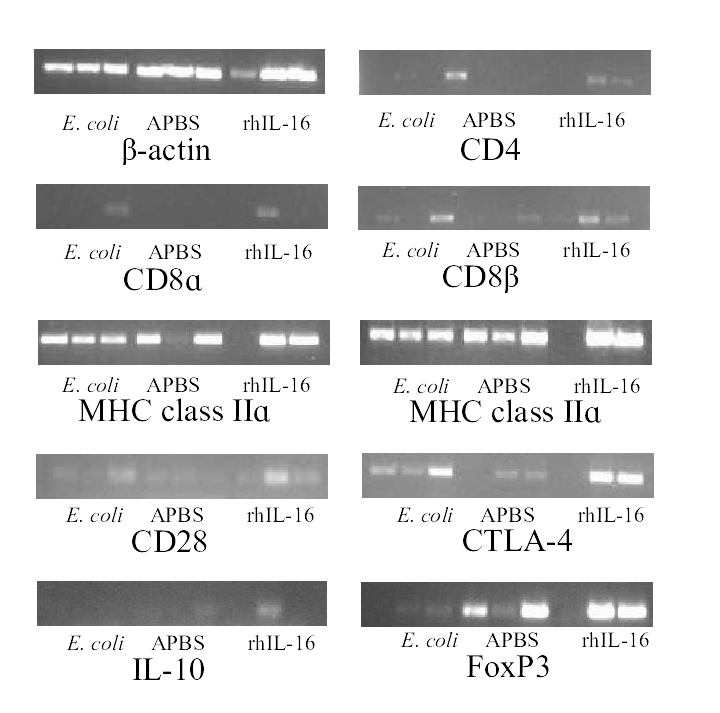
Figure 1: 2% gel electrophoresis of RT-PCR products of cDNA from peritoneal samples after injection with heat-killed E. coli, Amphibian Phosphate Buffered Saline (APBS), or recombinant human IL-16 (rhIL-16).
Acknowledgements
The authors would like to acknowledge the funding and resources provided by Stonehill College and by the family of Fr. Francis Hurley C.S.C.
References
2. Robert J, Gantress J, Cohen N, Maniero GD. Xenopus as an experimental model for studying evolution of hsp–immune system interactions. Methods. 2004 Jan 1;32(1):42-53.
3. Du Pasquier L, Robert J, Courtet M, Mußmann R. B‐cell development in the amphibian Xenopus. Immunological Reviews. 2000 Jun;175(1):201-13.
4. Yoshimoto T, Wang CR, Yoneto T, Matsuzawa A, Cruikshank WW, Nariuchi H. Role of IL-16 in delayed-type hypersensitivity reaction. Blood, The Journal of the American Society of Hematology. 2000 May 1;95(9):2869-74.
5. Cruikshank WW, Kornfeld H, Center DM. Signaling and Functional Properties of lnterleukin-16. International Reviews of immunology. 1998 Jan 1;16(5-6):523-40.
6. Center DM, Kornfeld H, Cruikshank WW. Interleukin 16 and its function as a CD4 ligand. Immunology Today. 1996;17(10):476-81.
7. Center DM, Cruikshank W. Modulation of lymphocyte migration by human lymphokines. I. Identification and characterization of chemoattractant activity for lymphocytes from mitogen-stimulated mononuclear cells. The Journal of Immunology. 1982 Jun 1;128(6):2563-8.
8. Cruikshank W, Center DM. Modulation of lymphocyte migration by human lymphokines. II. Purification of a lymphotactic factor (LCF). The Journal of Immunology. 1982 Jun 1;128(6):2569-74.
9. Richmond J, Tuzova M, Cruikshank W, Center D. Regulation of cellular processes by interleukin‐16 in homeostasis and cancer. Journal of Cellular Physiology. 2014 Feb;229(2):139-47.
10. Hermann E, Darcissac E, Idziorek T, Capron A, Bahr GM. Recombinant interleukin-16 selectively modulates surface receptor expression and cytokine release in macrophages and dendritic cells. Immunology. 1999 Jun;97(2):241.
11. Theodore AC, Center DM, Nicoll J, Fine G, Kornfeld H, Cruikshank WW. CD4 ligand IL-16 inhibits the mixed lymphocyte reaction. The Journal of Immunology. 1996 Sep 1;157(5):1958-64.
12. Ryan TC, Cruikshank WW, Kornfeld H, Collins TL, Center DM. The CD4-associated Tyrosine Kinase p56 Is Required for Lymphocyte Chemoattractant Factor-induced T Lymphocyte Migration. Journal of Biological Chemistry. 1995 Jul 21;270(29):17081-6.
13. Cruikshank WW, Center DM, Nisar N, Wu M, Natke B, Theodore AC, Kornfeld H. Molecular and functional analysis of a lymphocyte chemoattractant factor: association of biologic function with CD4 expression. Proceedings of the National Academy of Sciences. 1994 May 24;91(11):5109-13.
14. Gillis J, Uccello TP, Magri Z, Morris N, Maniero GD. Preliminary indications that recombinant human IL-16 attracts and stimulates lymphocytes of the amphibian, Xenopus laevis implying an ancestral role for CD4 as a cytokine receptor. Cytokine. 2020 Dec 1;136:155254.
15. Liu Y, Cruikshank WW, O’Loughlin T, O’Reilly P, Center DM, Kornfeld H. Identification of a CD4 domain required for interleukin-16 binding and lymphocyte activation. Journal of Biological Chemistry. 1999 Aug 13;274(33):23387-95.
16. Nicoll J, Cruikshank WW, Brazer W, Liu Y, Center DM, Kornfeld H. Identification of domains in IL-16 critical for biological activity. The Journal of Immunology. 1999 Aug 15;163(4):1827-32.
17. Center DM, Kornfeld H, Ryan TC, Cruikshank WW. Interleukin 16: implications for CD4 functions and HIV-1 progression. Immunology Today. 2000 Jun 1;21(6):273-80.
18. Wu DM, Zhang Y, Parada NA, Kornfeld H, Nicoll J, Center DM, Cruikshank WW. Processing and release of IL-16 from CD4+ but not CD8+ T cells is activation dependent. The Journal of Immunology. 1999 Feb 1;162(3):1287-93.
19. Bowers K, Pitcher C, Marsh M. CD4: a co-receptor in the immune response and HIV infection. The International Journal of Biochemistry & Cell Biology. 1997 Jun 1;29(6):871-5.
20. Wu H, Kwong PD, Hendrickson WA. Dimeric association and segmental variability in the structure of human CD4. Nature. 1997 May 29;387(6632):527-30.
21. Weiss A, Littman DR. Signal transduction by lymphocyte antigen receptors. Cell. 1994 Jan 28;76(2):263-74.
22. Lifson JD, Engleman EG. Role of CD4 in normal immunity and HIV infection. Immunological Reviews. 1989 Jun;109:93-117.
23. Chida AS, Goyos A, Robert J. Phylogenetic and developmental study of CD4, CD8 α and β T cell co-receptor homologs in two amphibian species, Xenopus tropicalis and Xenopus laevis. Developmental & Comparative Immunology. 2011 Mar 1;35(3):366-77.
24. Keane J, Nicoll J, Kim S, Wu DM, Cruikshank WW, et al. Conservation of structure and function between human and murine IL-16. The Journal of Immunology. 1998 Jun 15;160(12):5945-54.
25. Lynch EA, Heijens CA, Horst NF, Center DM, Cruikshank WW. Cutting edge: IL-16/CD4 preferentially induces Th1 cell migration: requirement of CCR5. The Journal of Immunology. 2003 Nov 15;171(10):4965-8.
26. Ogasawara H, Takeda-Hirokawa N, Sekigawa I, Hashimoto H, Kaneko Y, Hirose S. Inhibitory effect of interleukin-16 on interleukin-2 production by CD4+ T cells. Immunology. 1999 Feb;96(2):215.
27. Venet F, Chung CS, Huang X, Lomas-Neira J, Chen Y, Ayala A. Lymphocytes in the development of lung inflammation: a role for regulatory CD4+ T cells in indirect pulmonary lung injury. The Journal of Immunology. 2009 Sep 1;183(5):3472-80.
28. McFadden C, Morgan R, Rahangdale S, Green D, Yamasaki H, Center D, et al. Preferential migration of T regulatory cells induced by IL-16. The Journal of Immunology. 2007 Nov 15;179(10):6439-45.