

Abstract
Streptococcus pyogenes infection continues to be a worldwide public health problem causing various diseases in humans, including impetigo and oropharyngeal infections that are responsible for the development of rheumatic fever (RF), a multi-organ inflammatory disorder, Rheumatic heart disease (RHD) is its major sequel that leads to heart valves lesions, clinically classified as regurgitation and/or stenosis.
In the present work, we briefly describe the major events that lead to autoimmune reactions causing severe heart lesions in children and young individuals who are genetically susceptible to RF and RHD. We also present a summary of a vaccine development against S. pyogenes that would be a great advance in prevent the disease.
Keywords
S. pyogenes, Immune responses, Genes, Soluble mediators, Valve-lesions, Rheumatic fever, Rheumatic heart disease, Impetigo, Experimental model
Abbreviations
RF: Rheumatic Fever; RHD: Rheumatic Heart Disease
Commentry
Rheumatic fever (RF) is a non-suppurative sequel of a throat infection by group A Beta-hemolytic streptococcus (S. pyogenes) that affects not treated children and teenagers. The disease is immune-mediated and can cause serious troubles to the heart as pericarditis, myocarditis and valvulitis, leading to Rheumatic Heart Disease (RHD). Valvulitis is the major sequel of the disease with irreversible damage to the heart valves (Figure 1). Another manifestation of S. pyogenes infection is impetigo causing more frequently glomerulonephritis.
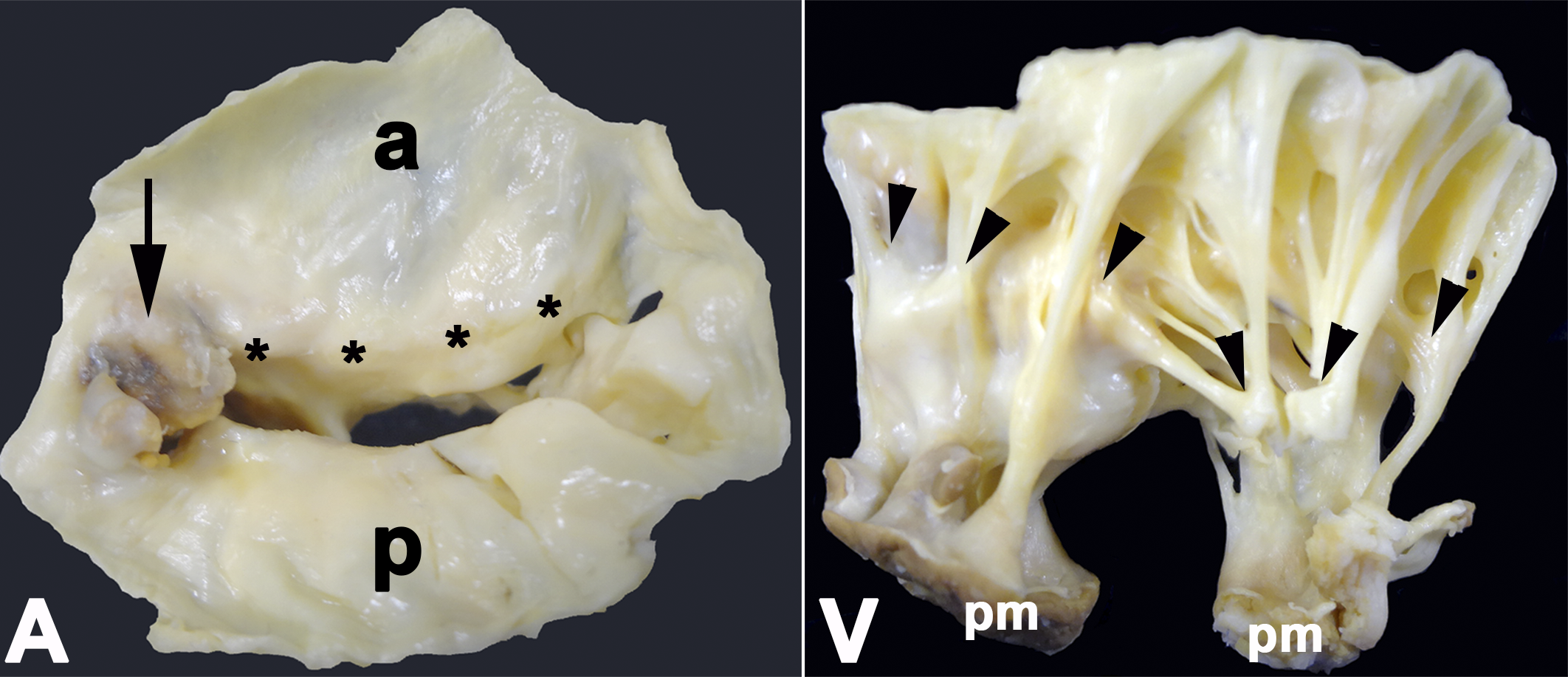
Figure 1: Postrheumatic mitral stenosis and incompetence, surgical excision. Atrial (A) and ventricular (V) aspects of mitral valve show thickening and distortion of cusps with commissural adherence and calcification (arrow) and retraction at the closure line (*). Chords are thickened, adherent and contracted (arrowheads) and there is fibrosis in the papillary muscle tips (pm). a and b- anterior and posterior cusps, respectively.
In the last 40 years several works described the genetic factors involved with susceptibility to the disease and its sequels. One of the first, described in 1979 was the 883 antigen present on B lymphocytes defined as an alloantigen [1], further characterized by monoclonal antibodies in 1985 [2]. Later, histocompatibility leucocyte antigens (HLA) were described being HLA-DR3 and DR7 alleles the most frequent associated with the disease [3].
In addition, single nucleotide polymorphisms of several genes responsible for control of both innate and adaptive immune responses were described more than 15 years ago, that showed a network of immune responses leading to autoimmune reactions that result on myocarditis and heart valve damage. Briefly, genes coding for mannose-binding lectin (MBL2), ficolin-2 (FCN2), mannose binding lectin associated with serine protease (Masp2), receptor for the Fc fragments of immunoglobulin G (FCγRIIA), tumor necrosis factor-alpha (TNFα), interleukin-1 receptor antagonist (IL1RA), tumor growth factor-beta (TGFß), toll like receptor 2 (TLR2), cytotoxic T cell lymphocyte antigen 4 (CTLA4), and macrophage inhibitory factor (MIF) were described and are involved with inflammatory reactions and host defenses against S. pyogenes and probably contribute to the development of valvular lesions [4].
More recently, a genome-wide association study (GWAS) of RHD susceptibility was done in mixed populations of eight Oceanian countries and allowed the identification of variants in Melanesian individuals. A novel susceptibility signal in the immunoglobulin heavy chain (IGH) locus centring on a haplotype of nonsynonymous variants in the IGHV4-61 gene segment corresponding to the IGHV4-61*02 allele [5].
The mechanism that drives the autoimmune reactions is defined as “molecular mimicry”, term introduced in 1964 by Damian [6] to explain the mechanism by which self antigens are recognized after an infection by virus or bacteria, initiating an autoimmune response.
Rheumatic fever is a model of an autoimmune disease, as a non-treated throat infection caused by S. pyogenes leads to heart-tissue damage in susceptible children and teenagers. In order to solve the infection, the organism start a cascade of cells, as neutrophils, B and T lymphocytes, monocytes and several soluble molecules such as chemokine, integrin, interleukins such as IL-2, TNF-alpha that create a milieu of an inflammatory process, culminating in autoimmune reactions in individuals with specific genetic factors that confer the ability to develop an autoimmune response.
The development of a vaccine to prevent S. pyogenes infection and its major sequels is a significant and challenge task. Efforts to produce an effective vaccine against streptococcal infections have been ongoing for more than 3 decades.
The importance of a vaccine development to prevent RF and mainly RHD was recognized by WHO global resolution [7]. Some models focus on the M protein based on N-terminal that covers specific serotypes, as reviewed by Steer et al [8]. StreptInCor another candidate vaccine is composed by 55 amino acid residues from C-terminal region [9,10] of M protein as a synthetic peptide, adsorbed in aluminum hydroxide and was already evaluated in pre-clinical assays in diverse animal models. No cross reactivity with heart tissue (pericardium, myocardium and valves) and other organs were observed, indicating that the candidate vaccine is safe [11-13].
Author Contributions Statement
Luiza Guilherme- Concept and write the article
Lea Demarchi- Write the article and valve macroscopic image
Jorge Kalil- Critically review
References
2. Zabriskie JB, Lavenchy D, Williams RC Jr, Fu SM, Yeadon CA, Fotino M, et al. Rheumatic fever-associated B cell alloantigens as identified by monoclonal antibodies. Arthritis Rheum. 1985 Sep;28(9):1047-51.
3. Guilherme L, Kalil J. Rheumatic fever and rheumatic heart disease: cellular mechanisms leading autoimmune reactivity and disease. J Clin Immunol. 2010 Jan;30(1):17-23.
4. Karthikeyan G, Guilherme L. Acute rheumatic fever. Lancet. 2018 Jul 14;392(10142):161-74.
5. Parks T, Mirabel MM, Kado J, Auckland K, Nowak J, Rautanen A, et al. Pacific Islands Rheumatic Heart Disease Genetics Network. Association between a common immunoglobulin heavy chain allele and rheumatic heart disease risk in Oceania. Nat Commun. 2017 May 11;8:14946.
6. Damian RT. Molecular Mimicry: Antigen Sharing by Parasite and Host and Its Consequences. Am. Nat. 1964;98:129-49.
7. White A. WHO Resolution on rheumatic heart disease. 2018; 39(48):4233.
8. Steer AC, Batzloff MR, Mulholland K, Carapetis JR. Group A streptococcal vaccines: facts versus fantasy. Current opinion in infectious diseases. 2009 Dec 1;22(6):544-52.
9. Guilherme L, Postol E, Freschi de Barros S, Higa F, Alencar R, Lastre M, et al. A vaccine against S. pyogenes: design and experimental immune response. Methods. 2009 Dec;49(4):316-21.
10. Guilherme L, Alba MP, Ferreira FM, Oshiro SE, Higa F, Patarroyo ME, et al. Anti-group A streptococcal vaccine epitope: structure, stability, and its ability to interact with HLA class II molecules. J Biol Chem. 2011 Mar 4;286(9):6989-98.
11. Guerino MT, Postol E, Demarchi LM, Martins CO, Mundel LR, Kalil J, et al. HLA class II transgenic mice develop a safe and long lasting immune response against StreptInCor, an anti-group A streptococcus vaccine candidate. Vaccine. 2011 Oct 26;29(46):8250-6.
12. Postol E, Sá-Rocha LC, Sampaio RO, Demarchi LMMF, Alencar RE, Abduch MCD, et al. Group A Streptococcus Adsorbed Vaccine: Repeated Intramuscular Dose Toxicity Test in Minipigs. Sci Rep. 2019 Jul 5;9(1):9733.
13. de Sá-Rocha LC, Demarchi LMMF, Postol E, Sampaio RO, de Alencar RE, Kalil J, et al. StreptInCor, a Group A Streptococcal Adsorbed Vaccine: Evaluation of Repeated Intramuscular Dose Toxicity Testing in Rats. Front Cardiovasc Med. 2021 May 11;8:643317.